
Hayden Gross
Helping companies and the people in them actually use AI.
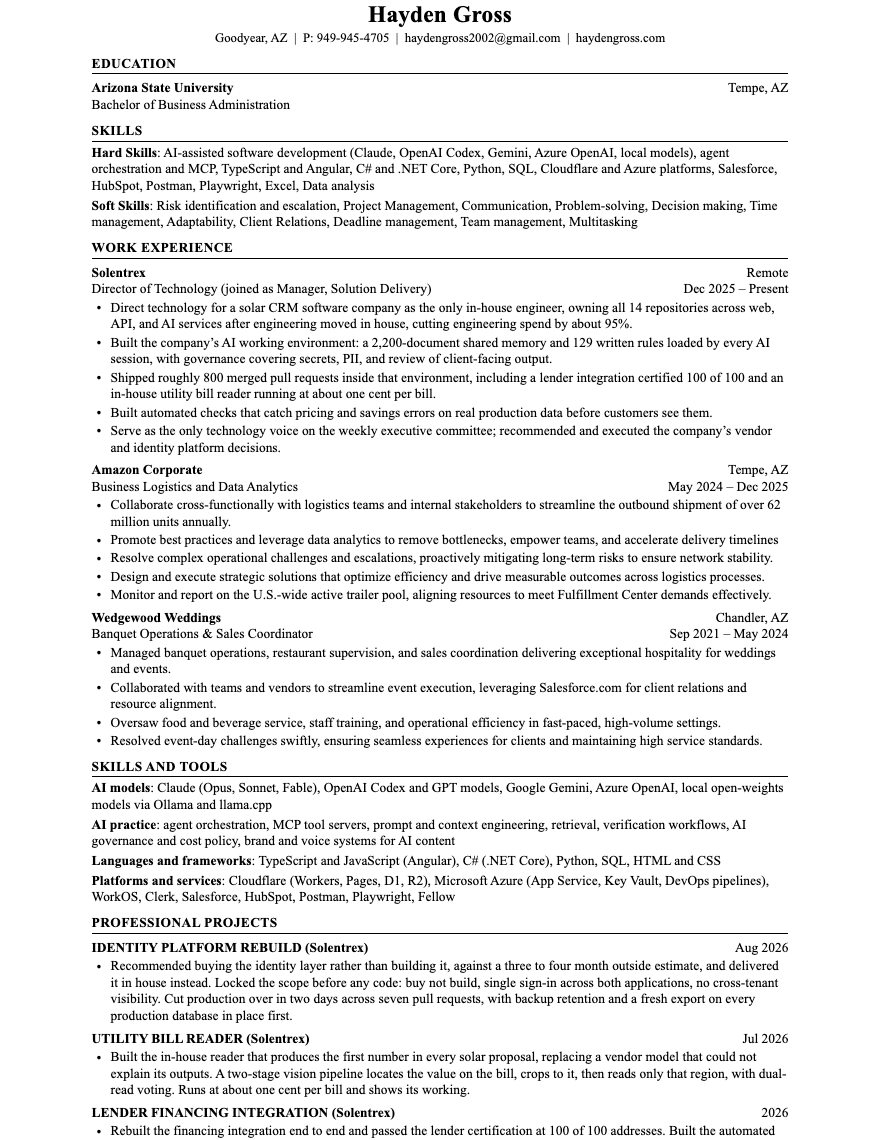
As the Director of Technology at Solentrex, I took over a 14-repository platform, moved engineering in house, and cut engineering spend by about 95%. Prior to this I worked at Amazon as a logistics analyst, where I created reporting workflows that sped up escalations and raised productivity across the network. My career began with three years at Wedgewood Weddings running banquet operations, and some of my most valuable lessons came from there: how different teams work together, and how to make quick decisions when the day does not wait.
Projects and documents

The working environment
A place every AI session runs inside.
The AI starts every job already knowing what happened on the last one. It follows rules I wrote down, it loads them without me remembering to, and nothing that reaches a customer or a dollar goes out unchecked. The point is that nothing has to be explained twice.
It is not only mine. The people with product context, not engineers, do the roof labeling that trains our model, and the website copy was written in house by the people who own the message; both work inside the same rulebook. The same setup, smaller, runs a family business.
What it produced
Work
Each page has the same shape: what it was, what I did, what it produced.
Building the memory system from scratch
From 116 disconnected files to a five-layer memory that loads itself, saves itself, and never asks me to explain twice.
The brand kit and the content system
A plain file the AI reads before it writes: colors, voice, always and never. Behind the company's AI content since April.
Two AI tools, one brain, and a written cost policy
Two different AI tools working from one rulebook, a written policy on which model to use and what it is allowed to cost, and people who do not write code getting real work done in them.
Taking over a platform from an agency
What the environment produced first: engineering moved in house, fourteen repositories on one person, spend down about 95%.
Lender certification, and the money math
Software shipped inside the environment passed certification, and I built the checks that catch pricing and savings errors before customers see them.
Everything else
An in-house bill reader at about one cent per bill, a vendor decision proven the same day, an identity rebuild, ML work, integrations. The full list.